





Muscle strength is more than just looks. It determines how easily we move, how confidently we master everyday life - and how independent we remain in old age. This article shows why muscles are the central health resource: for joints, metabolism, posture, brain performance, balance and quality of life. And it explains in practical terms how you can extend your "muscle span" - i.e. the period of time with strong, functional muscles - with little effort.
Brief summary
- Muscles are metabolic organs: they stabilize blood sugar, have an anti-inflammatory effect and increase the basal metabolic rate.
- From ~30 the breakdown begins: without counter-stimuli we lose strength and muscle mass - targeted training slows this down considerably.
- Function beats looks: if you can stand up easily, climb stairs safely and walk for long periods, you gain real quality of life.
- Short, regular stimuli are enough: 2-4 units per week, 15-30 minutes, combined with everyday steps and good sleep.
- Tools only as accelerators: Whether with or without devices - it's the routine that counts, not the equipment.
Why muscle strength is the underestimated health insurance
Strong muscles act as a versatile "health API" for your body. They relieve pressure on joints, stabilize the spine, secure your gait and keep your posture upright. At the same time, they increase energy consumption at rest, buffer blood sugar peaks and support hormonal balance. This can be seen in everyday life: from getting up without pain to the desire to walk another 500 meters instead of thinking "not today".
The older we get, the more this function counts. Because muscle strength determines independence: Can you go shopping on your own? Climb stairs without a handrail? Catch yourself after a stumble? Strength is the linchpin here - not cardio or stretching alone.
Musclespan: The years when you feel strong
"Lifespan" is the lifespan, "Healthspan" the healthy years. Musclespan focuses on the period of time in which your muscles are noticeably efficient: standing up, carrying, walking, lifting, stable standing. Natural muscle loss (sarcopenia) starts gradually from ~30 - if you do nothing, you lose noticeable substance every decade. Good news: even short, regular strength stimuli keep the muscles open for a long time.
In practical terms, this means less "I can't do it anymore" in everyday life and more "I can still do it". Those who cultivate this reserve look younger, move more fluidly and remain more independent.
The most important benefits of strong muscles (explained in everyday terms)
1) Joint protection & posture
Strong legs and a stable torso take the strain off your knees, hips and back. Many everyday complaints do not come from "too much use", but from insufficiently stable muscles. More strength means: cleaner movements, fewer avoidance patterns, better posture.
2) Metabolism & energy
Muscles are metabolically active. More muscle mass increases your basal metabolic rate, helps regulate blood sugar levels and supports fat burning. Subjectively, you feel more "awake" - stairs, walks and longer days require less energy.
3) Balance & fall prevention
Good lower leg and hip muscles improve stability, responsiveness and gait. This protects - statistically and perceptually - against falls and provides safety in everyday life.
4) Brain & mood
Regular muscle work promotes blood circulation, sleep quality and stress reduction. Many people report a clearer head, a better mood and greater everyday motivation - not because of "endorphin fairy tales", but because physical confidence feels fantastic.
5) Autonomy in old age
If you can still stand up safely at 70, carry shopping bags and climb stairs, you will live more independently. Muscle strength is the practical factor that noticeably extends your quality of life.
How to build up muscle strength for everyday use (without changing your life)
The recipe is simple: short, regular, progressive. You don't need monster sessions. The key is repetition - 2-4 times a week, 15-30 minutes. Start small, increase slowly, stay friendly and consistent.
The 20-minute basic plan
- Mobilize (2-3 min.): hips, shoulders, ankles. Gentle start instead of full throttle.
-
Main part (14-15 min.):
- Lower body: squats (chair), lunge holds, hip extension. Breathe calmly, move cleanly.
- Upper body: push-ups on wall/bench, rowing with band, pull-ups.
- Core/posture: Plank variations, dead bug, anti-rotation with band.
- Cooldown (2-3 min.): Swing out loosely, breath down, stretch briefly.
Tip: Leave 24-48 hours between intensive sessions. If you sit a lot, add 2-3 desk breaks (1-2 minutes) for the shoulder blades and hips.
Nutrition, sleep, everyday life: the three amplifiers
Protein & Timing
Distribute 2-4 portions of protein throughout the day. Combine with vegetables, good fats and complex carbohydrates - adapted to your activity level. Don't forget to drink.
Sleep & stress
7-9 hours of sleep will really make your progress visible. Short walks and breathing breaks act as little regeneration boosters.
Everyday life = bonus
Stairs instead of an elevator, 10-minute walks, short stretching breaks - all of these stabilize what you put on during training. Routine beats perfection.
Tools: nice to have - not mandatory
Whether dumbbells, bands or smart systems: they are aids, not requirements. If you like structured training, you can use wireless whole-body impulses to shorten the time (e.g. 20 minutes of focused stimulation, even at home). It remains important: You lead the movement, the tool only supports.
Transparency note: We have been working professionally with EMS/EMA systems for years and offer solutions for studios and at home. However, this article deliberately focuses on the benefits for the muscles - not the product.
Orientation for beginners & 60+
Start gently. Pay attention to clear movement, calm breathing and clean repetitions. If you are 60+ or have pre-existing conditions, please consult a doctor and increase your training slowly. The important thing is not "more", but regular and good exercise.
Conclusion: strength gives freedom
Muscle strength is one of the few levers you have in your hand at all times. It makes everyday life easier, keeps you independent and extends your muscle span - today, tomorrow and in old age. Start small, stay kindly consistent and allow yourself to get stronger.
Start smoothly, increase smartly
If you like structured support, you can also work with guided whole-body impulses - at home or in the studio. The decisive factor remains: your routine. Everything else is a bonus.
Visionbody: The booster for your everyday life
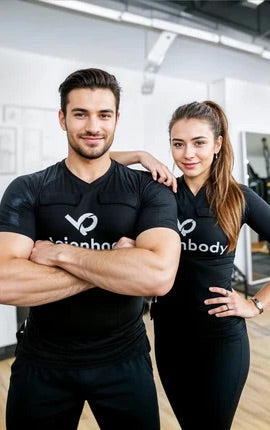
Muscles are the basis - routines keep them strong. If you also want a smart time reducer, a wireless full-body stimulus will help you: get dressed, select a program, work for 20 minutes with focus. This allows you to plan your training realistically - even between appointments, family and to-dos.
Why Visionbody makes the difference
- Time efficient: ~20 minutes per session - easier to fit into full weeks.
- Cordless & clean: dry electrodes, no gels, no cables - train at home, in the gym or outside.
- Whole-body stimulation: Even, deep activation - ideal when weights or equipment are not available.
- Joint-friendly: High training stimulus without heavy loads - good for back or knee problems.
- Focus on the lower leg: integrated calf electrodes support stability and gait pattern - a plus point for safety in everyday life.
- Flexible via app: 8 programs, 64 sub-programs - from strength to fat burning to regeneration.
- For beginners to athletes: Intensity can be finely controlled - you set the pace and level.
- Quality & durability: Developed for professional use - yet suitable for everyday use at home.
How to use Visionbody as an "everyday turbo"
- Set appointment block: 2-4×/week ~20 minutes each - fixed time makes the routine easier.
- Select a program: Strength/posture on office days, fat burning on cardio days, regeneration on stressful days.
- Combine with everyday life: After the session, go for a 10-15 minute walk or take the stairs - this enhances the effect.
- Increase slowly: check tolerance, increase intensity cautiously - quality before "more".
Result: More power, more control, more freedom
With consistent short sessions, you will noticeably regain your posture, stability and energy - without having to build your life around your training plan. That's why Visionbody is not a substitute for exercise, but a booster for what really counts in everyday life.